Understanding Arrowhead’s TRiM Platform
A practical guide to how Arrowhead builds RNAi medicines at scale

Opening
Arrowhead Pharmaceuticals is often described as a “platform company,” but that label can feel abstract without understanding what the platform actually is.
In Arrowhead’s case, the platform is called TRiM™—short for Targeted RNAi Molecule—and it underpins nearly every program the company develops.
This article is intended as an educational overview for readers new to Arrowhead. Rather than focusing on individual drugs or near-term milestones, it explains how TRiM works, how it expanded from the liver into multiple tissues, and why Arrowhead believes this platform approach changes the way risk, speed, and capital are managed in drug development.
Understanding TRiM is the key to understanding Arrowhead.
Part I — What TRiM Is (and Why It Exists)
At its core, TRiM™ is an engineered way to harness the body’s natural RNA interference (RNAi) mechanism to selectively silence disease-causing genes.
RNAi itself is not new: cells routinely use it to regulate protein production by degrading specific messenger RNA (mRNA) molecules before they can be translated into proteins. What TRiM provides is a practical, repeatable way to trigger that process inside specific human tissues.
What a TRiM molecule actually is
A TRiM molecule is built from a small number of modular components, each serving a distinct purpose.
The central element is a small interfering RNA (siRNA) designed to match a specific target gene. Once inside a cell, this siRNA is loaded into the cell’s RNA-induced silencing complex (RISC), which then uses it as a guide to find and destroy matching mRNA molecules.
This process is catalytic: a single siRNA can direct the destruction of many mRNA copies, leading to deep and durable reductions in the corresponding protein. That durability is one of the defining features of RNAi-based medicines, and it underlies Arrowhead’s ability to dose many TRiM candidates only a few times per year.
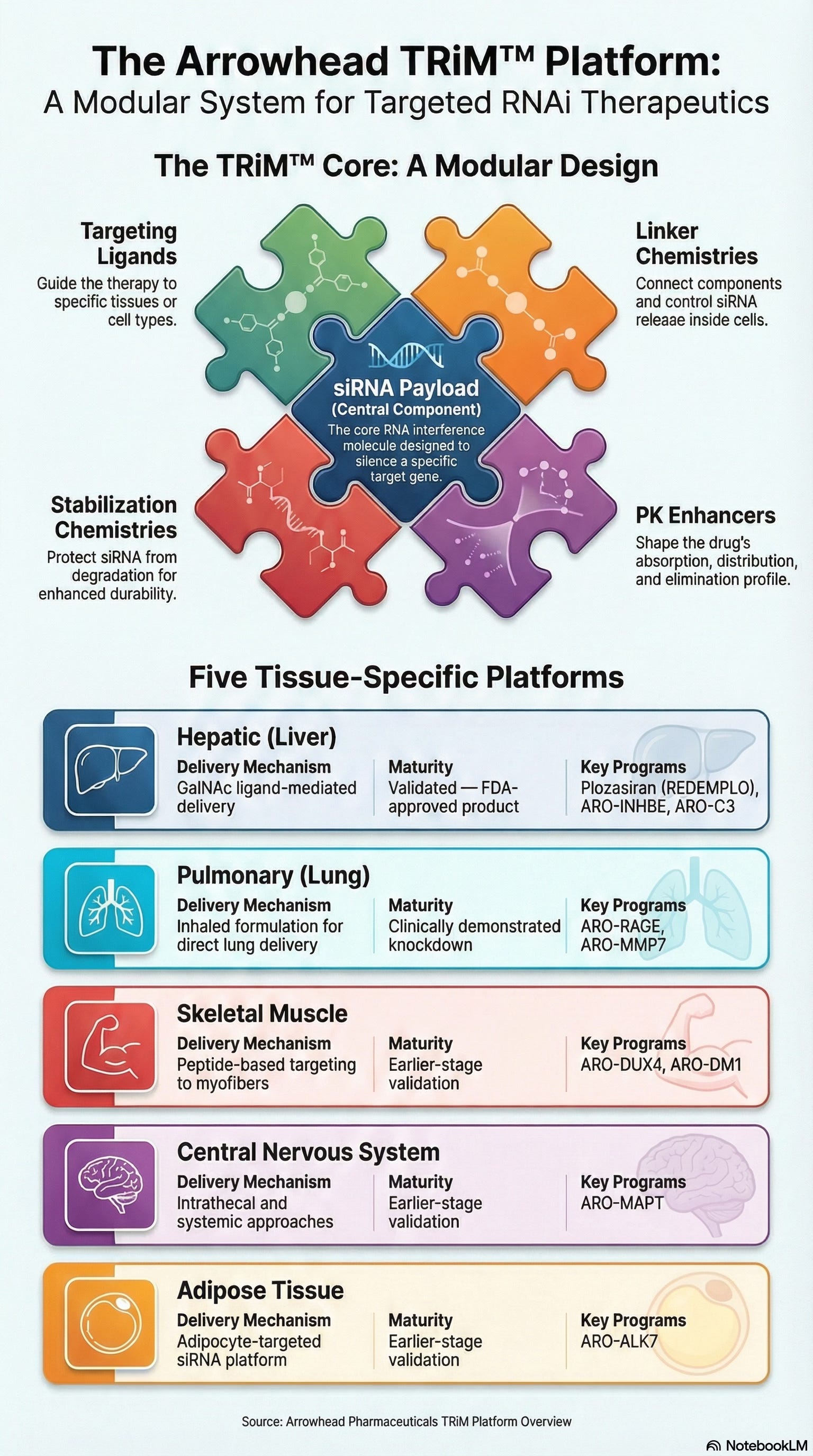
Surrounding the siRNA are additional components that make the system work in practice. Targeting ligands guide the molecule to a specific cell type. Linker chemistries connect the parts and control how the siRNA is released inside the cell. Stabilization and pharmacokinetic (PK) chemistries protect the siRNA from degradation and shape how long it persists in the body.
Importantly, these components can be adjusted independently, allowing the same basic design to be reused across different tissues.
Why TRiM was developed
Early RNAi drug efforts struggled not because the biology was wrong, but because delivery was hard. Many first-generation approaches relied on large delivery vehicles such as lipid nanoparticles or polymers, often requiring intravenous infusions and introducing additional sources of toxicity and complexity.
Arrowhead’s approach with TRiM was to remove as much of that complexity as possible. By designing small, chemically defined molecules that incorporate targeting and stability directly into their structure, the company aimed to widen the therapeutic window and enable more patient-friendly routes of administration, such as subcutaneous injection or inhalation.
In Arrowhead’s own framing, TRiM emerged from a deliberate effort to simplify RNAi delivery rather than layering on increasingly elaborate delivery systems.
What “validation” means in the TRiM context
When Arrowhead talks about validating a TRiM platform, it is not referring to regulatory approval. Validation, in this context, means demonstrating that a particular delivery approach can safely and durably reduce gene expression in humans within a specific tissue.
The company typically points to three indicators. First is depth of knockdown: large reductions in target protein levels. Second is durability, allowing for infrequent dosing. Third is translation, meaning that effects observed in preclinical models—especially non-human primates—reliably predict what is seen in human studies.
Once those criteria are met for a given tissue, Arrowhead treats the underlying delivery strategy as proven. That distinction matters, because it shifts how subsequent programs are evaluated: success is no longer tied solely to whether RNAi works in that tissue, but to whether a particular gene is the right one to target.
From mechanism to platform
This combination of modular design and tissue-level validation is what turns TRiM from a single technology into a platform.
Arrowhead often summarizes this idea with the observation that RNAi itself does not “care” which gene is being silenced. Once delivery is solved for a given cell type, the same machinery can, in principle, be applied to many different targets within that tissue.
The sections that follow build on this foundation.
First, we’ll look at how TRiM expanded from its original focus on the liver into multiple tissues across the body. Then we’ll examine why Arrowhead believes this platform approach reduces risk, accelerates development, and supports a distinctive partnership strategy.
Part II — From Liver to Everywhere: TRiM as a Multi-Tissue Platform
Once the basic TRiM design was established, Arrowhead’s early development efforts focused on a single, pragmatic question: where could RNAi delivery be made to work first, reliably and at scale? The answer was the liver.
The liver as the proving ground
Hepatocytes offered a uniquely favorable starting point. They are highly accessible from the bloodstream, express well-characterized surface receptors, and play a central role in producing circulating proteins implicated in metabolic and genetic diseases.
Arrowhead optimized TRiM for hepatocyte delivery using N-acetylgalactosamine (GalNAc) ligands, which bind receptors highly expressed on liver cells and enable efficient uptake following subcutaneous administration.
Early clinical results in liver-targeted programs demonstrated deep and durable gene silencing, validating not just individual drug candidates but the underlying delivery approach itself. Over time, this liver platform supported a growing portfolio of programs spanning cardiometabolic disease, genetic liver disorders, complement-mediated diseases, and obesity.
The FDA approval of REDEMPLO (plozasiran) marked a commercial milestone, but in Arrowhead’s internal framing, the liver platform had been “working” long before that point.
More importantly, the liver experience established a pattern that would shape everything that followed: once delivery was solved at the tissue level, Arrowhead could rapidly generate multiple candidates by changing the target gene while reusing the same core chemistry.
Breaking the liver barrier
For years, RNAi was widely viewed as a liver-restricted modality. Arrowhead’s next strategic move was to challenge that assumption by extending TRiM beyond hepatocytes into tissues with very different biological and anatomical constraints.
The lung was an early focus. Rather than relying on systemic circulation, Arrowhead developed inhaled TRiM formulations designed to deliver siRNA directly to pulmonary epithelial cells. Clinical data demonstrating target knockdown in human lung tissue represented a significant inflection point: RNAi delivery was no longer confined to the liver, and TRiM could be adapted to local, tissue-specific administration routes.
That success opened the door to additional tissues.
Skeletal muscle, long considered difficult to access with nucleic acid therapies, became addressable through peptide-based targeting strategies designed to deliver TRiM molecules directly to myofibers. In parallel, Arrowhead advanced approaches for the central nervous system, including both intrathecal delivery and systemically administered constructs designed to reach deep brain regions. More recently, the platform has been extended to adipose tissue, enabling direct modulation of genes involved in metabolic regulation.
Each of these expansions required new delivery solutions, but they all shared the same underlying logic: adapt the targeting and pharmacokinetic components while preserving the core RNAi machinery.
Tissue platforms, not isolated drugs
As TRiM expanded into new organs, Arrowhead began to describe its pipeline less as a collection of individual drug programs and more as a set of tissue-specific platforms or “franchises.” In this framework, a liver TRiM platform, a pulmonary TRiM platform, or a muscle TRiM platform is defined by how delivery is achieved, not by which gene is targeted.
This distinction matters. It explains why progress in one program can have implications far beyond that single indication.
When Arrowhead demonstrates reliable delivery and gene silencing in a new tissue, it effectively establishes a reusable foundation for future candidates in that same tissue. Subsequent programs benefit from accumulated knowledge around dosing, durability, safety, and chemistry, even if the biological targets differ.
The accompanying infographic is intended to visualize this idea. At the center is a modular TRiM core—composed of the siRNA payload and supporting chemistries—that remains constant across programs. Surrounding that core are tissue-specific delivery strategies, each defining a distinct platform based on how the molecule reaches its target cells. The lower section highlights the major tissue platforms Arrowhead has disclosed to date, along with representative programs and their relative stages of validation, illustrating how a shared molecular framework is adapted across organs rather than reinvented for each disease.
Different stages, same logic
Not all tissue platforms are equally mature. Liver-directed TRiM programs are the most established, with extensive clinical experience and a marketed product. Pulmonary delivery has demonstrated clinical gene knockdown, while muscle, CNS, and adipose platforms are at earlier stages of validation. Arrowhead has been explicit about these differences.
What unites them is the company’s consistent development strategy. Each new tissue is approached as a delivery problem to be solved first, before scaling into multiple targets. In Arrowhead’s telling, this approach transforms what might otherwise be a series of one-off development bets into a structured expansion of a single technological system.
It’s also worth noting that Arrowhead is not alone in developing RNAi medicines—other companies, including Alnylam, have successfully advanced RNAi therapies, particularly in liver-directed disease—but this article focuses on how Arrowhead frames TRiM as a multi-tissue platform rather than on comparative performance across approaches.
The final section of this article turns to the consequences of that structure.
Part III — Why Platforms Change Risk, Speed, and Capital Use
By this point, the logic of TRiM as a multi-tissue platform should be clear. What remains is the practical question: why does Arrowhead believe this structure changes the economics and probabilities of drug development itself?
The company’s answer centers on three related ideas: risk reduction through reuse, speed through repeatability, and capital efficiency through leverage.
Risk shifts from delivery to biology
In traditional drug development, each new program often carries the full weight of uncertainty. Even when a biological target is well understood, questions around delivery, exposure, durability, and safety must be re-answered repeatedly.
Arrowhead argues that TRiM changes where that uncertainty sits. Once a delivery strategy has been validated in humans for a given tissue—demonstrating deep, durable gene knockdown with acceptable safety—the company treats that delivery problem as largely solved. Subsequent programs using the same tissue platform no longer need to prove that RNAi can reach and function in that cell type. Instead, the primary remaining question becomes whether silencing a particular gene produces the desired clinical effect.
Repeatability enables speed
The same platform logic underpins Arrowhead’s emphasis on development speed. Because TRiM programs share core chemistry, manufacturing approaches, and development playbooks, new candidates can be advanced without rebuilding the process from scratch each time.
This repeatability allows multiple programs to move forward in parallel across different tissues, informed by prior experience rather than starting from a blank slate.
Capital efficiency by design
Platform reuse also shapes how capital is deployed. Once the TRiM core and a tissue-specific delivery strategy are established, incremental programs can be pursued at a fraction of the original cost.
Arrowhead frequently links this structure to capital efficiency: a single technological investment can support programs across multiple disease areas, while standardized processes reduce duplication and bottlenecks.
Why partnerships fit the model
This same logic helps explain Arrowhead’s partnership strategy. By partnering non-core programs, the company brings in non-dilutive capital while retaining ownership of its most central franchises. In Arrowhead’s framing, partnerships monetize the breadth of the platform without distracting from internal priorities.
Platform Expansion
Beyond its currently disclosed tissue platforms, Arrowhead has consistently described TRiM as an extensible architecture rather than a closed system. The company has stated a long-term objective of expanding delivery capabilities to additional cell types over time, without publicly specifying which tissues may come next. This framing reflects Arrowhead’s view that RNA interference reaches its full therapeutic potential only if it can be applied across diverse organ systems, while leaving the pace and scope of future expansions intentionally open-ended.
Putting it together
Taken together, these elements explain why Arrowhead emphasizes TRiM as a platform rather than any single drug. The thesis is not that platforms eliminate risk, but that they reorganize it—reducing repeated uncertainty while focusing attention on the biology that matters most.
A note on limits and uncertainty
It’s important to be clear about what this framework does—and does not—establish.
This article has focused on how Arrowhead itself describes the TRiM platform and why the company believes it changes the dynamics of drug development. That perspective explains the structure of the pipeline and the strategy behind it, but it does not eliminate uncertainty.
Platform approaches carry their own risks. Reuse can amplify success, but it can also concentrate failure if underlying assumptions about delivery, durability, or safety prove incomplete when extended to new tissues or patient populations. Progress in one program does not guarantee success in another, even within the same platform, and biological targets remain inherently uncertain. TRiM shifts where risk resides; it does not remove it.
Seen in that light, the value of the platform thesis is not that outcomes are assured, but that learning accumulates. Each program tests not only a target, but the boundaries of the delivery system itself. Whether that accumulated knowledge ultimately translates into durable advantage is something only continued clinical results can answer.
Closing
Arrowhead’s TRiM platform is best understood not as a collection of individual drugs, but as a reusable system for solving delivery, durability, and scale across tissues. That system does not eliminate biological uncertainty, but it reshapes where that uncertainty resides and how often it must be confronted from scratch.
For readers following Arrowhead over time, this perspective offers a useful lens. Pipeline updates are rarely isolated events. More often, they are signals about how the underlying platform is performing—and about what may be possible elsewhere within it.
In that sense, TRiM is not just a technology Arrowhead uses. It is the framework through which the company builds.
Not investment advice. Do your own due diligence.